
March 13, 2026
How Monticello Outside Helps Restore Childhood
Ted Gioia recently shared a sobering list about the state of childhood today. Among the facts he cites:
- the average child now plays outside for only 4 to 7 minutes a day
- time spent with friends has fallen in half
- half of children surveyed say their parents should be concerned about their screen time.
Childhood is becoming more screen-based, more sedentary, and less connected to the real world.
At Monticello Academy, we are trying to answer that problem with something concrete: Monticello Outside, our outdoor education program for grades 4–8.
What Is Monticello Outside?
Monticello Outside is a vertically aligned outdoor and environmental education program designed to help students connect with the natural world, strengthen social and emotional well-being, and grow in character through real-world, hands-on experiences.
It grows out of a simple conviction: children need more adventure, more wonder, more physical competence, and more direct contact with the world beyond a screen.
We want children doing real things.
We want them reading real books, making real music, building real friendships, and growing through real challenge. We want them outside. We want them moving. We want them learning that confidence does not come from comfort or constant entertainment, but from doing hard things well.
Outdoor Education in Utah for Grades 4–8
Monticello Outside gives students the chance to experience Utah’s landscapes not as spectators, but as participants.
In 4th grade, students begin by building comfort and confidence in mountain environments through ski or snowboard instruction. They learn perseverance, mountain safety, and respect for Utah’s alpine ecosystem.
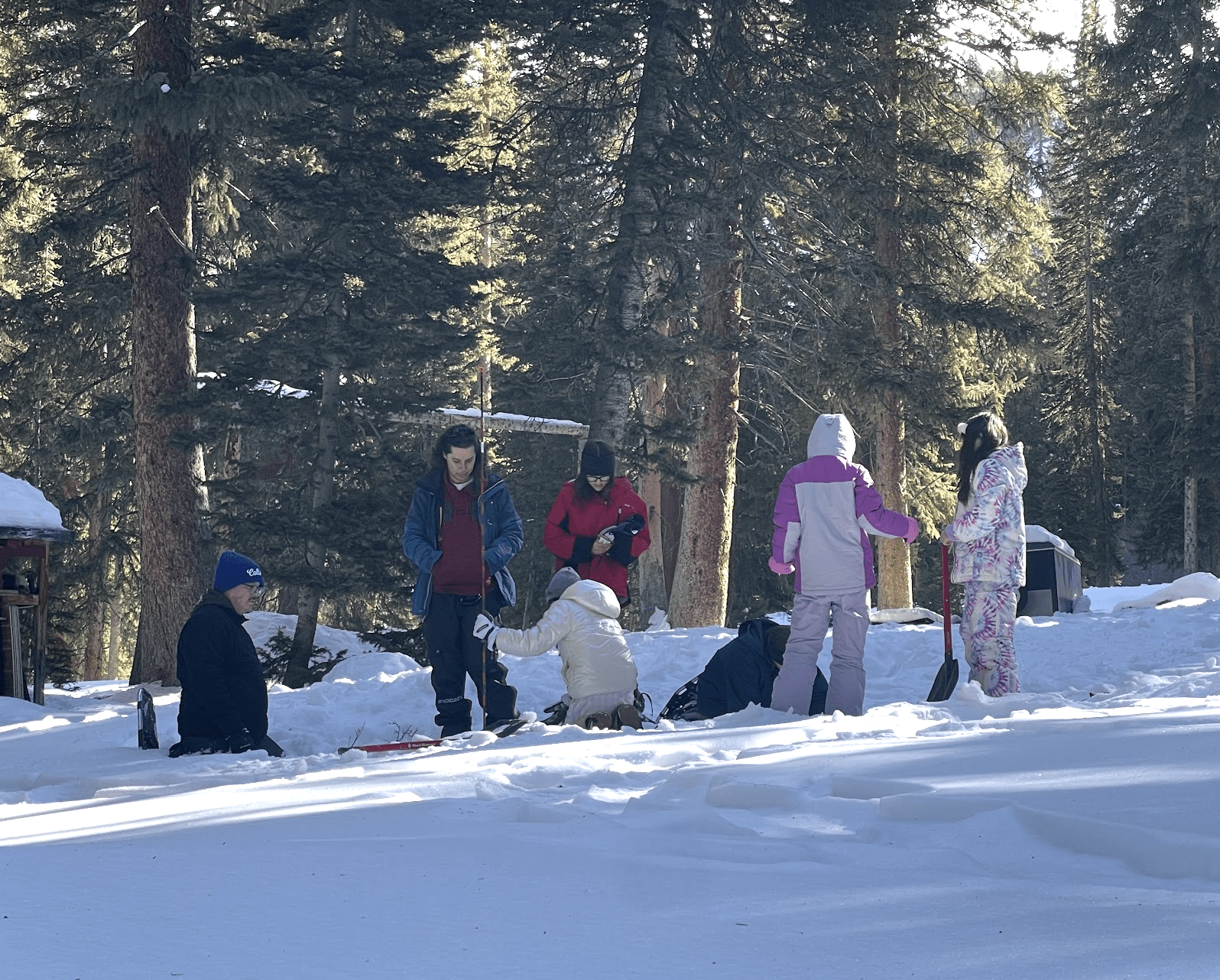
In 5th grade, students participate in Snow School in Big Cottonwood Canyon, where they dig snow pits, measure snow depth and density, and study how mountain snowpack sustains Utah’s water systems.
In 6th grade, students explore watershed and river ecology by kayaking the Jordan River, testing water quality, and tracing the connection between snowmelt, waterways, and the Great Salt Lake.
In 7th grade, students deepen their environmental science learning through habitat study, biodiversity surveys, ecological modeling, and field-based observation.
In 8th grade, the sequence culminates in a capstone experience at Headwaters Ranch in Boulder, Utah. There, students take part in camping, canyoneering, astronomy, regenerative agriculture, art, music, survival skills, and ecological fieldwork.
Why Real-World Learning Matters
This is not outdoor education as a nice extra.
It is part of our response to the kind of childhood too many children are living now.
If children are spending less time outside, we should get them outside. If they are spending less time with friends, we should give them shared experiences that build friendship. If anxiety is rising, we should help them discover the calm and confidence that come from competence, responsibility, and age-appropriate risk.
That is what Monticello Outside is for.
Students do not just learn scientific concepts in the abstract. They see them, test them, and experience them. They grow in resilience, teamwork, stewardship, and gratitude. They learn to pay attention. They learn to work together. They learn that the world is not merely something to consume. It is something to know, care for, and take part in.
How Monticello Academy Responds to a Screen-Filled Age
Monticello Outside reflects something larger about Monticello Academy.
We believe education should form the whole child: mind, body, and character.
Childhood does not need to be handed over to screens, isolation, and low expectations.
It can still be full of beauty, challenge, friendship, and joy.
That is the kind of childhood we want to help restore at Monticello Academy.